

For a healthier throat
Spineband is a revolutionary Swedish aid for anyone who has a sore neck, strains their neck on a daily basis or does not want to expose it to neck pain in the future.


0,2 kg
Weight
40%
Back relief
40%
Reduced muscle fatigue
40%
Hold the holding task for longer
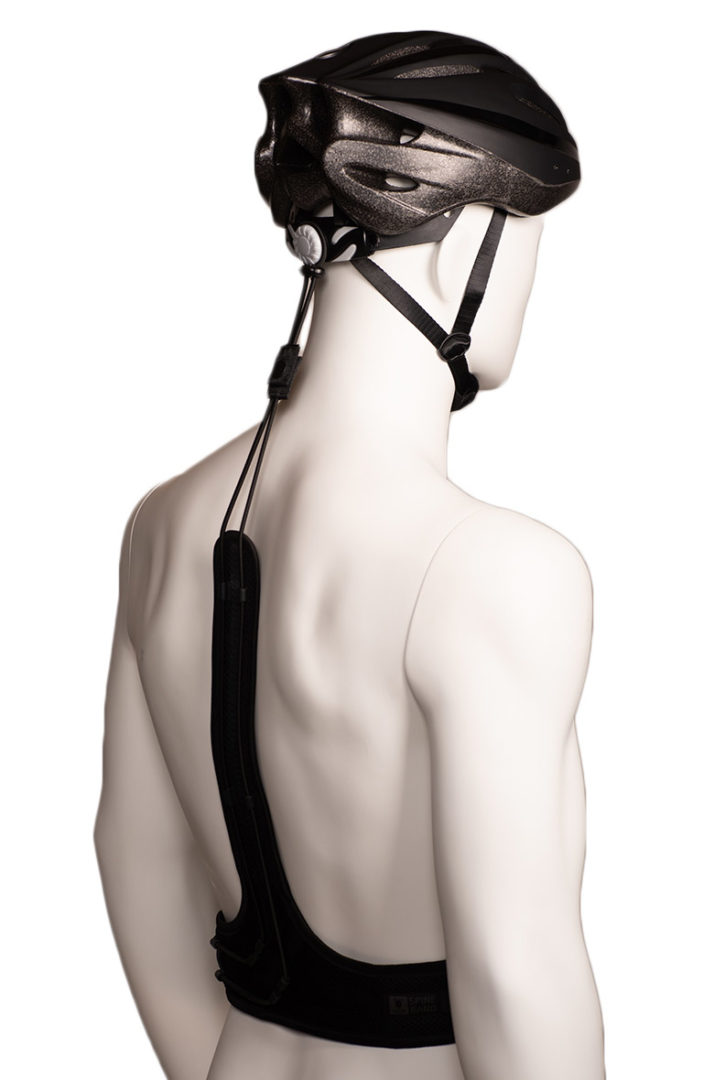
Spineband
Around 10 % of the Swedish population suffers from neck pain, half of whom are disabled as a result of their pain. In industry today, various forms of protective equipment are required, which can weigh down the head and cause additional strain on the neck.
We are here to minimise the problems
Spineband is a revolutionary Swedish aid for anyone who suffers from neck pain or overstrains their neck on a daily basis and does not want to expose it to further stress. Spineband helps the neck muscles to relax so that you can avoid neck pain forever!
Why do you have neck pain?
Evolution has adapted the human body to hunting so that we can look out for danger and use our bodies and necks. In today's society, we don't live this way, we are much more static.
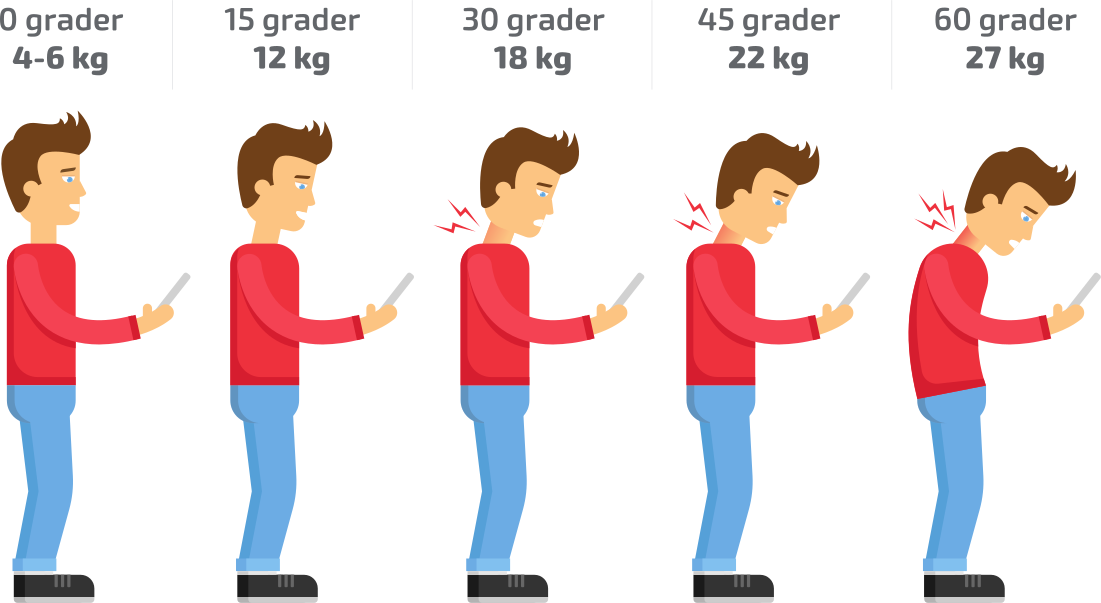
The head of a full-grown person weighs around 5 kg. If we tilt our head forwards by 30 degrees during a shift as a tattoo artist or fitter, the force exerted on the neck is three times as high. If you work as a welder or in another profession that requires additional equipment such as a helmet, the strain on the neck increases even further.
Grazing animals such as cows or horses have an elastic tendon in their neck, evolution has given them a "backbone of nature". This means that they are not affected by a forward leaning posture like we humans are. Humans also have an elastic tendon, but unfortunately it is not as pronounced in us humans.
Why does vulture cause pain?
Fencing neck leads to a hunched posture and the shoulders being pushed slightly forwards. This leads to neck pain and signs of wear and tear on the neck and shoulders. It is not only screens that can cause this type of neck pain. Any form of one-sided use in static positions often causes pain. Professions such as welders, cooks and carpenters are just a few examples of occupational groups at risk.
When our neck is bent at a 60-degree angle (i.e. with the nose pointing towards the floor or the mobile phone), the neck muscles have to work with forces that are slightly more than five times normal. This is a strain on the neck that inevitably leads to damage in the long term. The illustration shows how much strain the head puts on the intervertebral discs between the vertebrae at different angles.
(Grader - Grade)
Results for neck pain
If a skilled worker is in pain during the shift, this can lead to lower productivity and efficiency. It can also lead to a poorer bottom line and lost production. Not to mention the increased medical costs for employees and employers, as well as the increased stress for colleagues.
- Lower productivity
- High costs for sick leave
- High costs for medical care
- Higher workload for colleagues
- Lower quality of life

"Back and neck problems account for most cases of illness. Musculoskeletal disorders, especially neck and back problems, are by far the most common occupational illness among women and the fourth most common among men."
Department of Intervention and Implementation Research in Occupational Medicine, Institute of Environmental Medicine, Karolinska Institutet 2018
When do I use Spineband?
There are two purposes for using Spineband: for prevention and for healing. If you are using the Spineband for prevention, we recommend that you use the Spineband if you risk putting too much strain on your neck due to a static neck posture.
For neck problems, we recommend using the Spineband for 30-60 minutes a day. You can use it while walking, watching TV or doing another everyday task. For best results, use it in conjunction with neck strengthening exercises.
30-60 minutes
You only need to use the Spineband for 30 to 60 minutes a day.
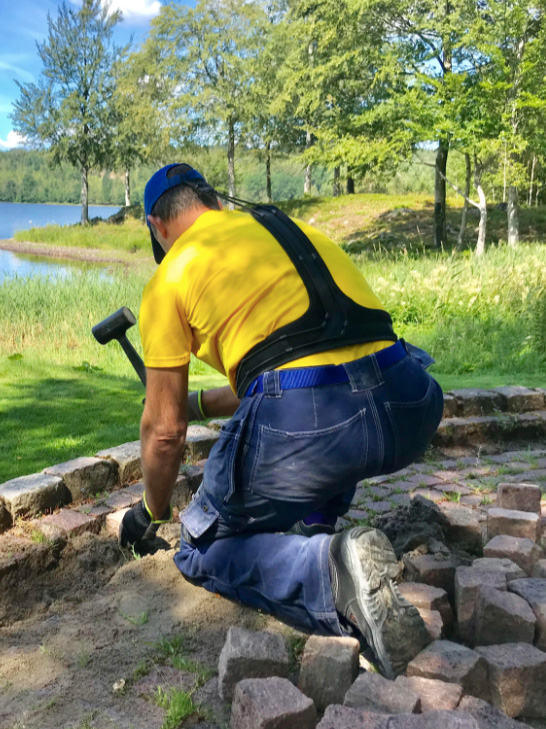
How should I use Spineband?
For the Spineband to work and be comfortable, it is important that you use the product correctly. An easy way to test whether you are using the Spineband correctly is to stand upright with the Spineband on. In this position you should not feel the Spineband at all, only when you tilt your head forwards should the Spineband receive and provide support.
Adjustable
You can easily adjust the size so that your Spineband fits both your body and the support your neck needs.
Relief
Spinal belts help to bring the neck into a natural position to relieve pressure on the neck and support correct posture.
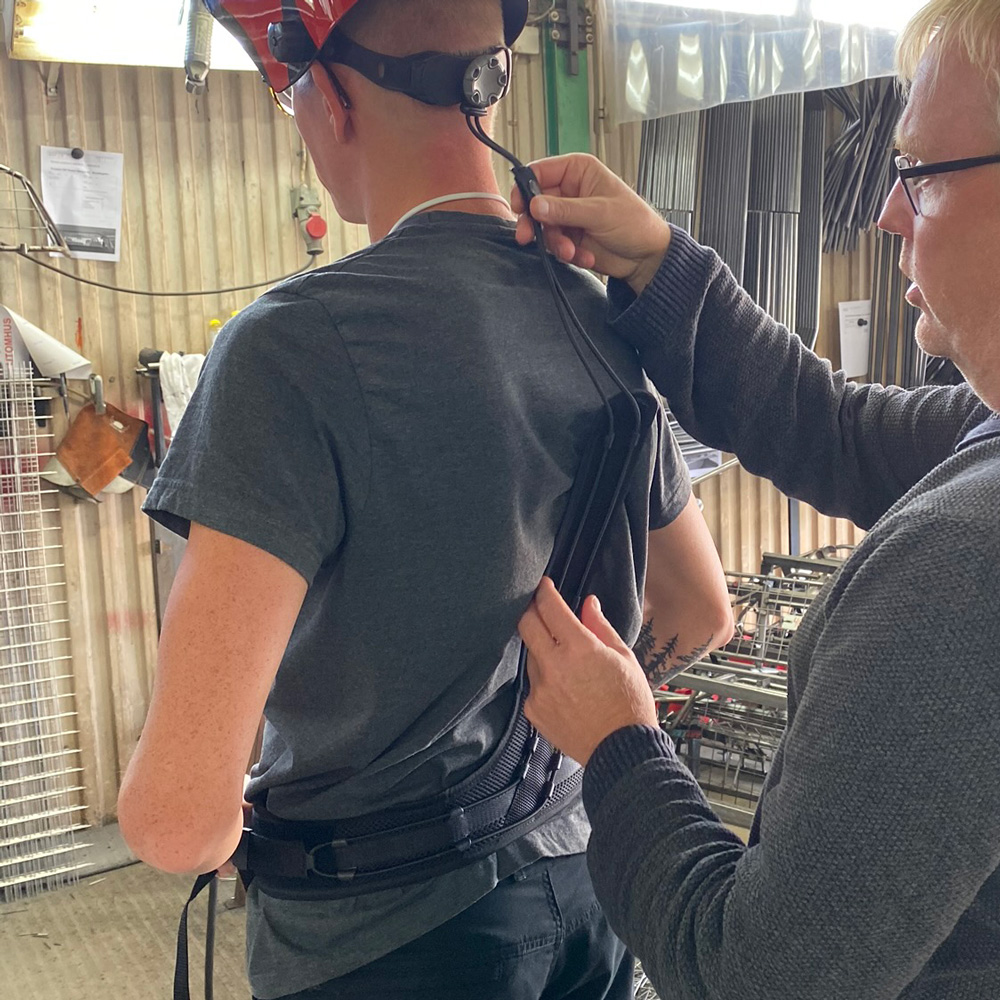
Accessories
There are four accessories that you can use with Spineband.

Clamp
Enables the spineband to be attached to a cap.

Elasticated loop
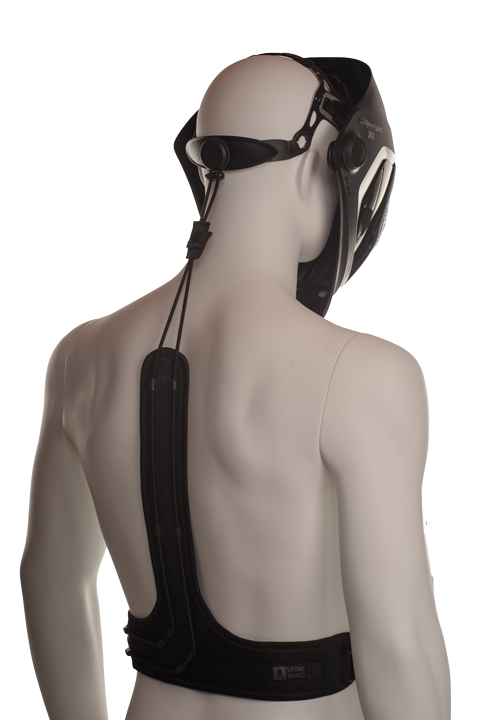
Enables the Spineband to be attached to various helmets.

Head ring
Allows the spineband to be used without a headband.
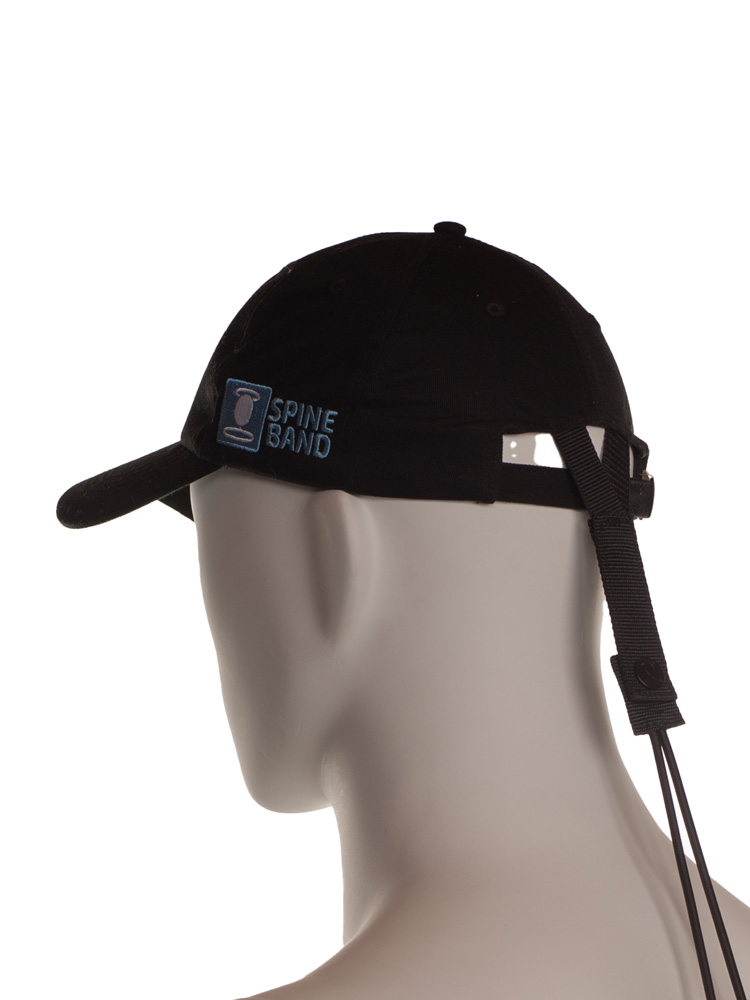
Cap
Spineband's own cap with integrated clip.
Who is Spineband suitable for?
Some professions put strain on the neck and shoulders. Neck pain can occur in any work situation and can have many different causes. For example, incorrect strain or overloading of the neck, a monotonous working position. We don't just cater to a specific occupational group, we also address you with neck pain.
Do you work in welding, assembly, carpentry, in front of a computer or in another monotonous or strenuous working position that can cause neck pain? With the help of Spineband you can avoid pain and injury to your neck in the future.
Office work
Most people who work in front of a computer have experienced discomfort and tension in their neck. Spineband offers pleasant relief when working in front of a computer or can be used, for example, during a walk in the lunch break. Tests have shown that even a 30-minute application per day over a period of 1 to 2 weeks leads to a reduction or complete disappearance of pain.
Welding
Welding is strenuous work, often carried out in a bent-forward position with heavy equipment. It can be exhausting to work for a whole day without causing pain or tension in the neck. Spineband attaches easily to the helmet's adjustment wheel and reduces the weight load on the head and helmet, reducing strain on the neck muscles. When you use Spineband, you have full freedom of movement and do not restrict your professional performance, but the other way round!
Earthworks / Construction work
People who work in an exposed environment with high physical strain often suffer from neck pain and feel exhausted after a hard day's work. A walk with Spineband during your lunch break or a walk on the way to and from work are examples that can help reduce neck, back and shoulder pain. Spineband can be easily attached to the back of the work helmet using the elasticated loop.
Forestry
Working with heavy machinery puts a lot of strain on the neck, shoulders, back and arms. The elasticated loop of the spine strap can be easily attached to the adjustment button on the back of the helmet. In this way, you can be relieved of strain during work. It can make a difference, after the end of the working day you can feel greater pleasure in your neck and back.


What does VGK "forward facing head posture" mean?
We are not used to a life in front of a screen
We humans are engineers, we are constantly evolving, but our DNA is not so fast. It takes several thousand years for evolution to make changes to our body and its structure. In some cases, this slow but sure evolution has a negative effect on us because our bodies are not fully designed for what we want to do. An example of this is sitting in front of a screen, be it on a computer, mobile phone or tablet. This works.
The average person spends several hours a day in front of a screen. The tablet, smartphone and work computer affect several factors in our body, one of the biggest being the neck. When we sit in front of a screen, we often adopt an unnatural posture. The head and neck are bent forwards and downwards. If you are constantly in this position, you can get a so-called skirmish (also known as VKG).

How does the Spineband help with neck pain?
Rolf Wirhed, lecturer at Örebro University, explains how Spineband helps with neck pain.
Muscles that fight each other
The movements in the various joints of the body are controlled by muscles. A single muscle causes the movement in a joint to take place in a certain direction. There is always a muscle that performs a movement in the other direction in the same joint. These two muscles are known as antagonists. One wants to and can do one thing, while the other wants to do the exact opposite. The body is so skilful at controlling movement that when one muscle wants to perform a movement, its antagonist relaxes so that the movement is not slowed down or prevented altogether.
You can try this out very easily. Sit on a chair in front of a table. If you press your palm on the table with your bent arm (i.e. try to extend your elbow joint), you can feel with your other hand that the elbow flexor muscle (biceps), which is located at the front of the upper arm, is completely loose and relaxed. It is the antagonist of the extensor muscle (triceps) and should not hinder it in its attempt to extend the elbow. If you feel the back of your arm when you press, this muscle is tense and hard.
Now do the opposite by holding your hand under the table and trying to "lift" it. Your upper arm will then be hard and tense on the front and loose and limp on the back. The spinal cord is based on the fact that when a muscle is tense, its antagonist relaxes.

Why is it important to activate the neck muscles to avoid neck pain?
When the neck muscles are tense, the neck muscles relax. The muscles around the cervical spine are numerous and complex. This is why we refer to all the muscles that bend the head forwards so that the chin reaches towards the chest as neck muscles and those that hold the head up and bend it backwards as throat muscles. If you can get the neck muscles to hold the head in the right place instead of the neck muscles, the neck will get the relaxation and rest it needs.
The Spineband has an elastic band that is stretched in such a way that the head is bent backwards a little too much. You are now forced to tense your neck muscles so that your head is in the right place and the neck muscles are automatically forced to relax. Sim sala bim! As if by magic, you can hold your head in position without tensing your neck muscles. You can rest while the neck muscles and the slightly taut elastic band ensure that your head is in the correct position.

Relieve the strain on your neck muscles with Spineband
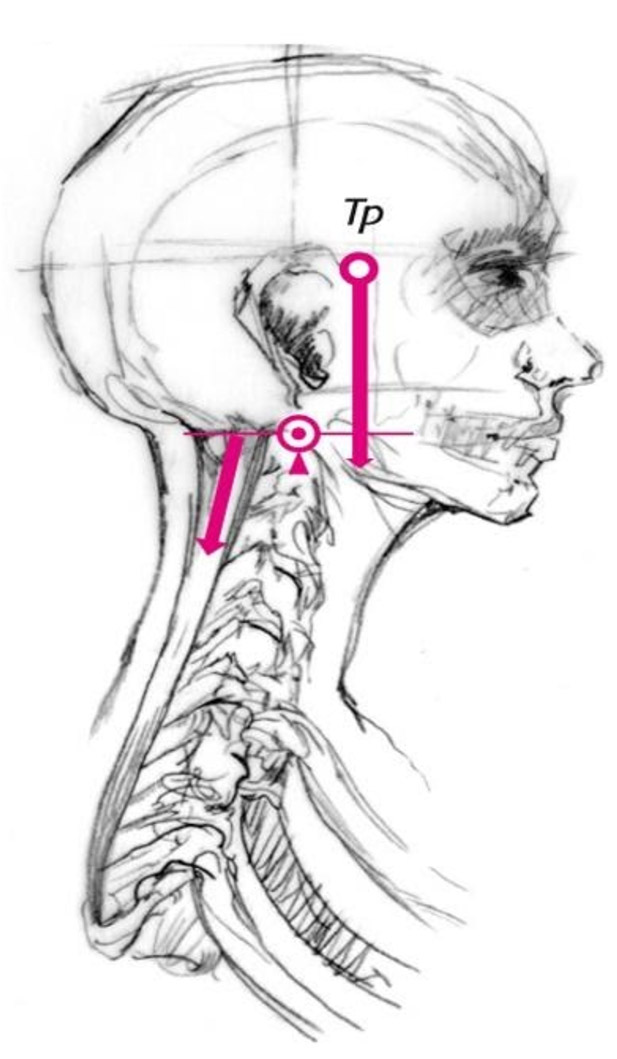
The illustration shows how the weight of the head (approx. 5 kg) with its centre of gravity (Tp) is about 3-5 cm in front of the upper cervical vertebra. The neck muscles are located at approximately the same distance behind the same cervical vertebra. If you imagine the cervical vertebra as the centre of a seesaw, the neck muscles have to pull the head backwards with a force of just under 5 kg.
The muscles are built for this and should be able to cope with it without any problems. If you now imagine that the head is bent forwards, then the force arrow of Tp on the rocker moves further and further outwards and requires more and more strength from the neck muscles to stabilise the head in the new, more strenuous position. If the neck muscles are worked over a longer period of time with loads that can be 2-3 times higher than normal, this leads to fatigue and pain that can become chronic.
With the Spineband, which relieves the neck muscles even in a normal working position, you have a good opportunity to get rid of your very unpleasant neck problems and train your injured muscles at the same time.
The article was written by Rolf Wirhed.

Rolf Wirhed has been a lecturer at Örebro University for many years. He has a degree in physics from Stockholm University, supplemented by training in anatomy in Uppsala. Rolf Wirhed is the author of the classic Anatomy with Movement Theory and Strength Training (2012), a book that is highly recommended as in-depth literature for Biomechanics (2014).
How does the neck work?
The structure of the neck
The neck, or cervical spine as it is also known, allows the head to rotate 90 degrees in any direction. It carries one of our most important organs, the brain. You could almost say that if the head is the crown, the neck is the throne. As with almost all other mammals, our neck consists of seven vertebrae. The top two, the atlas and the axis, are the most important for the head's ability to move. Together they form the upper cervical joint.
In this part of the neck there is a deflection of movement. Thanks to the vertebral joint between the two vertebrae, the atlas vertebra can rotate from side to side around its axis, as the axis has a cylindrical vertical protrusion. In addition to these important vertebrae, we also have two muscle groups that are important both for the motor function of the neck and for posture. Nick and the neck muscles, which are opposed to each other. This means that when one muscle group wants to do something, the other muscle group wants to do the opposite. Although the muscles want different things, they work together. While the neck muscles want something, the neck muscles relax and vice versa. They work in symbiosis, like yin and yang.
What is the difference between pitching and neck muscles?
The muscles that bend the head forwards with the chin pointing towards the chest are called the neck muscles. The muscles that hold the head up and bend it backwards are called the neck muscles.

Atlas vertebrae
The Atlas vortex is named after a giant from Greek mythology, the same giant after whom our map books are named. But why is a vortex named after a giant? The story goes that Atlas carried the globe on his shoulders. The analogy is that the Atlas vertebra supports our head.
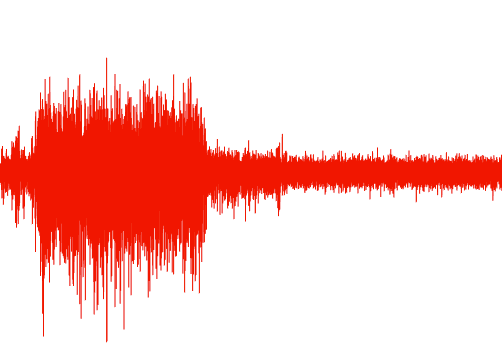
EMG test performed by authorised personnel in a university environment
Today's sedentary and monotonous work contributes to neck pain, a hidden disease that affects around 40 % of the Swedish population. Spineband is here to change that. The revolutionary technology relieves the neck and eliminates pain.
What is EMG?
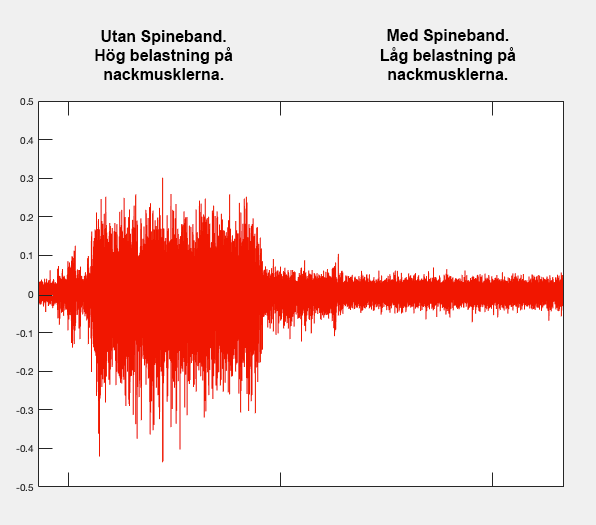
EMG, or electromyography as it is actually called, is a method used in medicine. The test measures the physical ability of nerves and muscles to conduct electrical signals. The results are presented in a graph that shows how the neck muscles are stressed. If the frequency in the muscles is high, the muscles are under greater strain, and if the frequency is low, the strain on the muscles is also low.
Left: Without spine band. High strain on the neck muscles
Right: With spine strap. Minimal strain on the neck muscles
How does Spineband affect the load?
When the elastic lines on the Spineband are tightened, the muscle activity of the neck is reduced, which in turn relieves the neck muscles. The diagram below clearly shows how muscle activity decreases significantly when the elastic lines of the Spineband are tightened. When the ropes are taut, the Spineband works together with the neck muscles instead, allowing the neck muscles to relax.
How should Spineband be used to achieve the same result?
If you use Spineband for 30-60 minutes a day, you relieve the neck muscles to such an extent that the pain is reduced or completely eliminated. Spineband is therefore perfect for a long walk, on a bike ride or on the sofa with your toad or phone. If you already have pain in your neck, we recommend Spineband Original, a sturdy waistcoat that will help you get rid of neck pain. If you don't have any pain yet but are constantly putting a lot of strain on your neck, we recommend Spineband Active instead. This model is more stylish and perfect for the workshop or office.
Keep your head straight at the end
Rolf Wirhed has been a lecturer at the University of Örebro for many years. He holds a licence in physics from the University of Stockholm, complemented by training in anatomy at Uppsala. Rolf is the author of the classic Anatomy with Motion Theory and Strength Training (2012), a book that is highly recommended as a reference book for Biomechanics (2014).
 English (UK)
  Deutsch
  Français
  Italiano
  Español
  Polski
  Dansk
Dansk  Svenska
  Čeština